
Heidi Øiseth: Loose Ends
July 9 - August 6, 2026
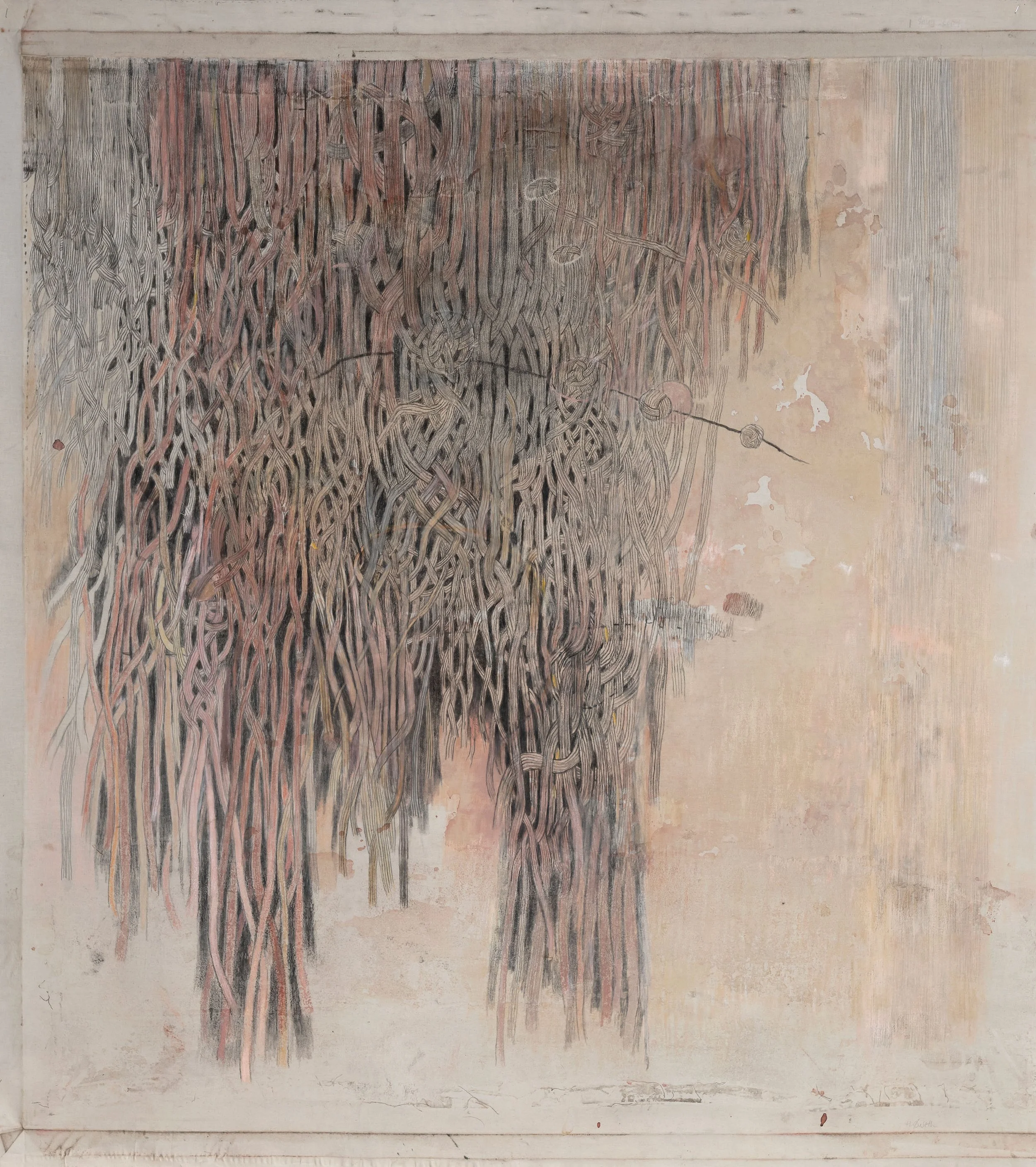
The Loose Ends series is freely drawn and inspired by the intricate patterns (Celtic knots) of the Middle Ages. Such braided motifs were used in textiles, wood carving—particularly in the portals of stave churches—and metalwork.
These works hang like tapestries, which throughout history have served as carriers of images, symbols, and intuitive expressions of life. During the Middle Ages, intricate patterns embodied something mysterious and sacred, evoking eternity and divinity. The warp threads and their intricate, intertwined lines become a pathway—an expression of life and the soul, and ultimately of destiny.
In the Völuspá (the Poetic Edda), the Norns spin the threads of fate—the inevitable threads that bind together life and the universe.
Urðr represents the past. She governs all that has been.
Verðandi represents the present—the process of becoming.
Skuld represents the future—what is yet to come.
The woven lines suggest that everything is interconnected. The patterns and the knot itself carry meanings associated with holding fast, perseverance, and protection. They also functioned as powerful symbols safeguarding against misfortune and dark forces. Witches were said to braid knots from their own hair to protect themselves, preserve their integrity, bind malevolent powers, or even bind—or release—love.
The meticulously drawn tapestries in this series therefore carry shadows of the past while simultaneously creating new cycles of life. The warp threads extend downward across the surface until they gradually dissolve into the unknown. The chalk-drawn lines lend the works a material quality reminiscent of woven fabrics, tapestries, and textiles hanging on the walls of a room—like a membrane or protective layer that carries forward the symbolism of the past.
The richness of detail and subtle tonal variations evoke a physical sensation of something unresolved, while also opening a window—a possibility of looking beyond the surface, into what lies beneath: memory and history.
This body of work has evolved over many years, making the dimension of time an essential part of its meaning. The works speak to the time it takes to understand—a contemplative process that also characterized the Middle Ages—where the slow labour of the hand encounters surfaces worn by time. Gradually, these surfaces emerge as thought, as an inner dialogue, and as a process of coming to terms with the events of life.