
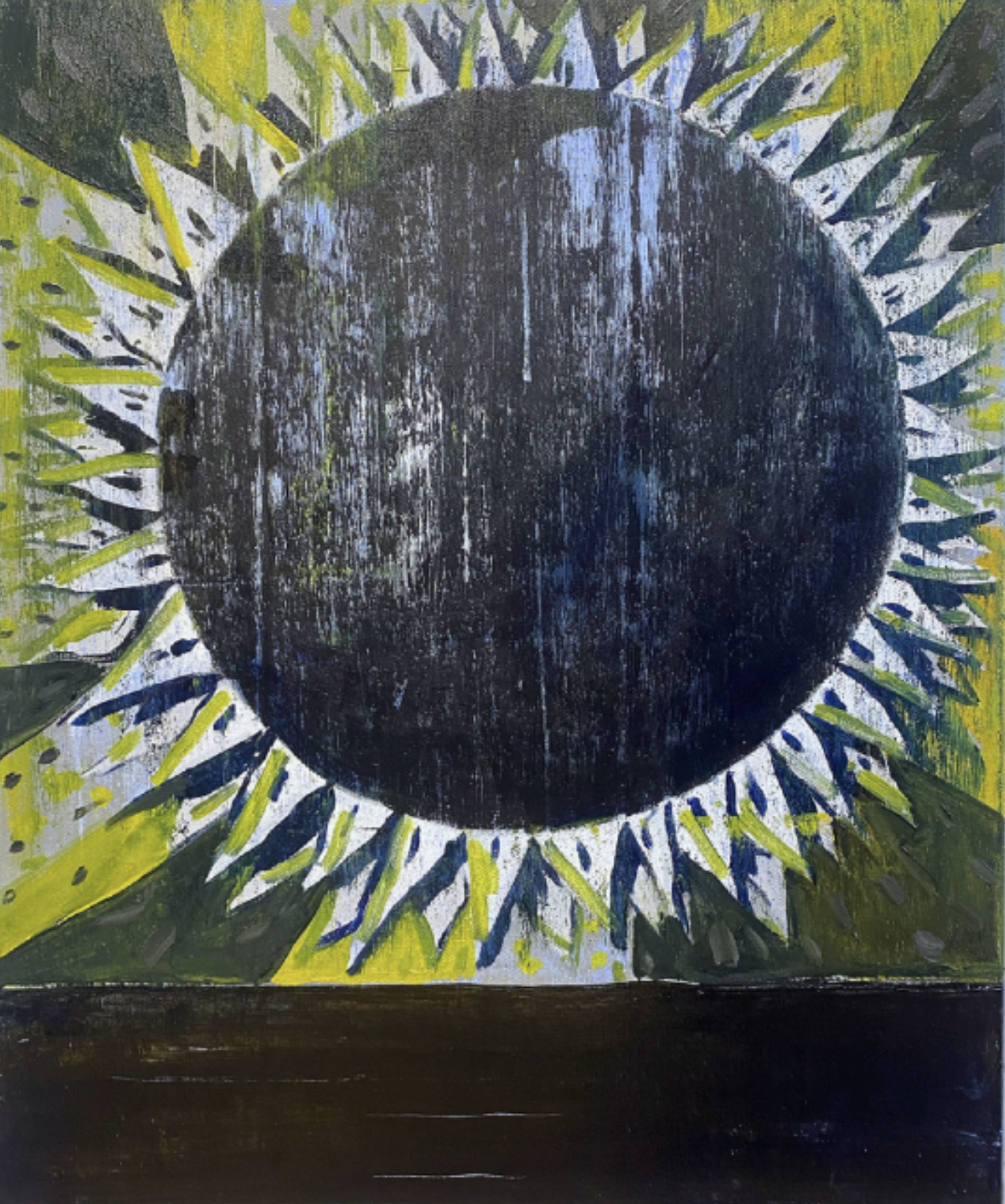
Yngvar Larsen
Perennis, 2026
Oil on canvas
60 x 50cm
I was in the car on the way to Louisanna to see Lucian Freud. I thought of something Lau Albriktsen had told a class in art history at the Art School sometime in the 80s. He had told me about the black light in Russian icons, God's light that was painted black, as a negation of God's light because no one can paint God's light. I googled and found somOrthodox icons, one where God's hand came out of a black "cloud" and another where Jesus sat in heaven in a black hoe. What struck me was that the icons had the same composition as the painting series Perennis that I have been working on for the last 6-7 months. A floating black circle forms over a simplified landscape. The pieces kind of fell into place. While I have been painting these paintings, I have thought that they have something infinite about them. The fact that I used simple stencils means that they can all be repeated, copied endlessly. In the same way that icons are copied and multiplied.
A couple of months ago I was at the National Museum and looked at the icons there. What struck me at the time was that the people had no shadows, they didn't hover, but there were no shadows that appeared on the ground. When I told Britt about it, she replied: ! Oh, that's because they are holy, they are not people.
There is something surreal about these icons. People float, they appear in the sky enveloped in black light. Everything is illuminated, but the sun creates no shadow, there is nothing to show that there is a three- dimensional space with physical people who stop the sun's rays and create shadows. When I started thePerennis series, it was the memory of an installation I made in 1995 that I wanted to take up again. At that time I had hung a red piece of cloth as a flag on which I projected a negative photo of a sunflower. It was one of these installations I have made that no one really saw, but which I have never forgotten. It appeared as a red flag with an unpainted motif.
Since the slides are long gone and the documentation is deep in a plastic box with thousands of photos, I started googling sunflowers. I finally found a picture of a hand holding up a sunflower as big as a head. That was the start of the series. But I didn't paint the stem, so the circular shape wasn't grounded, it never became a flower. The floating flower shape became a surrealist shape that hovers over a dark horizon.
While the painting process took over and chance came into play, I thought about my own connection to Russia because of my daughter-in- law from Moscow. Putin's war has prevented us from meeting our Russian family, so maybe it's a Ukrainian sunflower hanging there in the sky like an eye from which tears flow, or is it the moment a bomb explodes? Or a solar eclipse, some eternal evil that has manifested itself. Surrealism came as a reaction to the brutality of the battlefield during World War I. They believed that the absurd was the only way to deal with the horrors of war.
When I was looking for reference images, I found a picture of a scaly man standing on what looked like a sunflower or a solar eclipse. Next to the scaly man was the Latin inscription Putre factio! Rotten feast, Maybe this is it? Many of the artistic ideas I have worked on deal with infinity or large sizes. The painting series Marengo can hold 20,000 paintings, one painting for each horse killed in the Battle of Waterloo. A Cup for Every Wild Tiger (2016), consists of 3,900 hand-painted cardboard cups. Endless Columns / the bamboo is laughing , which consists of glued plastic cups, can continue indefinitely, limited only by time, space and the finances at your disposal.
The Perennis series has no conceptual limitations, the only thing limiting the series is that I get hit by boredom, or that I experience that the subject is painted into pieces.
In the painting series where the subject composition is repeated, it is not the quantity that is important, but the repetitions like other repetitions in life. The sun rises, the sun sets, no day is the same, but they have the same structure, even if one day the sky is blue and another day gray.
The composition of the Perennis series has the same function as the frames that the day provides, and the opening to the variation on a level, all painting is about painting, the joy of putting a layer of wet paint on the canvas. So these series are not about producing "masterpieces", but about having these processes as part of my life. Picasso wrote dates on everything he made. For him it became creating a long diary, some days are bad, many are okay, and some are wonderful.
I'm sitting in the cafe at the Neue Nationalgalerie drinking radler, 50 lamps hang above me, and the walls are covered with something that at first glance looks like wallpaper, but on closer inspection is 3-dimensional tiles that are affected by perspective. All the similar elements merge into a higher unity.
Yngvar Larsen